Moving up to Year 5 marks a new stage for every child, as it is the first step into secondary school. Life becomes more grown-up, and learning becomes more structured. In Year 5 German lessons, children move beyond simple games or memorising individual phrases. Year 5 pupils gradually begin to grasp grammar, learn to express their thoughts coherently and construct full conversations.
A modern German textbook for Year 5 should not be a tedious collection of rules, but a dynamic tool that keeps the child engaged. A high-quality textbook helps pupils get to grips with the subject easily and stay motivated.
In this article, we’ll look at how to choose the right German learning materials for Year 5, what topics pupils can expect, and how to make learning as comfortable as possible.
An introduction to learning German in Year 5
In Year 5, German can be studied as either a first or second foreign language. The intensity of the programme and the depth of the material covered vary depending on this. The main objective of the academic year is to consolidate the knowledge acquired in primary school or to gently immerse the pupil in the language environment from scratch.
The learning process is structured around the development of four core skills: listening, reading, speaking and writing. To ensure children remain motivated, modern textbooks actively incorporate situational learning. Every grammar rule or new set of vocabulary is immediately practised in simulated real-life situations.
An overview of German textbooks for Year 5
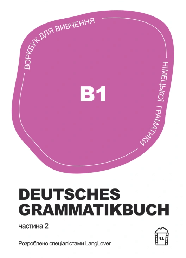
Choosing a high-quality textbook determines the success of the entire academic year. Our catalogue features both domestic textbooks and teaching resources from leading European publishers, adapted for Ukrainian schools.
A modern edition aimed at teenagers. It contains vivid visual diagrams, up-to-date vocabulary and is aligned with the New Ukrainian School (NUS) curriculum.
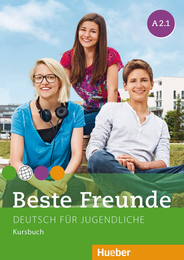
Beste Freunde A1.2 / A2.1
C. Seuthe et al. (Hueber)
A classic German language course with a storyline centred on the lives of teenagers. Excellent for developing conversational and communication skills.
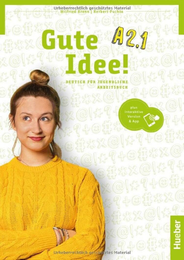
Gute Idee! A2.1
Various authors (Hueber)
An interactive course featuring a wealth of communicative exercises, project-based tasks and digital resources.
Textbooks are available both in standard printed form and as part of a package including electronic interactive platforms. Please check the contents of individual series with our managers or in the catalogue.
Main topics and sections of the Year 5 German course
The Year 5 syllabus covers topics relevant to teenagers: describing one’s appearance, family and friends; discussing school life and timetables; hobbies and leisure activities; everyday life; shopping; and favourite foods. Pupils also learn about the culture and festivals of German-speaking countries.
Tips for learning German effectively in Year 5
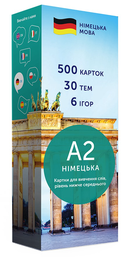
For easy and effective learning, it is best to spend 20 minutes a day on the language rather than cramming for long periods. Flashcards will help to quickly expand vocabulary, whilst a workbook (Arbeitsbuch) will firmly consolidate grammar and writing skills. It is also useful to immerse oneself in the language environment through audio and video resources.
You can find and purchase the resources you need in our catalogue. High-quality, adapted literature will also be beneficial for your child’s overall development, allowing them to read fiction suited to their current level of proficiency (A1–A2). Our staff are always on hand to help you choose the right book or series.
FAQ
Which German textbooks are recommended for Year 5?
It is recommended to use publications that have been approved by the Ministry of Education and Science of Ukraine and meet the New Ukrainian School (NUS) standards. Popular and effective series include ‘Perfekt für die Ukraine’, ‘Beste Freunde’ and ‘Gute Idee!’ from the publishers Hueber and Dinternal Education.
How do I choose a German textbook for Year 5?
When choosing a textbook, take into account the child’s level of preparation (whether they have studied the language before or are starting from scratch), and check for the availability of a workbook, audio resources and interactive materials. If the school follows a specific curriculum, refer to the recommended teaching package.
What teaching methods are used in Year 5 German lessons?
The communicative approach forms the basis. Teachers use pair and group work, game-based activities, project-based tasks, listening exercises and interactive maps to develop practical speaking skills.










 ArrivalsNew Sale