






Tips for teaching spoken English

Oleksandra Kulish
Book expert
The first thing that might come to mind for a novice teacher who has decided to teach mainly conversational English is that this format of teaching sounds more ‘relaxed,’ “fun” and ‘easy.’ Most experienced teachers will just smile at this idea, knowing that any kind of teaching, even if it's exciting, is almost never ‘easy’ or ‘carefree.’
Moreover, it should be noted that often you have to deal with beginners who need to learn basic vocabulary for communication in various fields ‘quickly and efficiently’ — working with people who have no understanding of the basics of the language can be extremely difficult. And, as we know, we do not choose our students. That is why it is necessary to have sufficient experience and knowledge to ensure that the training is high-quality and effective.
How conversational English differs from academic English
Although conversational English lessons may indeed be less formal than, for example, an academic writing course, they have their own challenges. For example, in writing classes, we know exactly what to give students. In general, this is the ability to write basic essays with an emphasis on grammar, punctuation, and sentence structure. In contrast, a conversational English course has less defined boundaries.
However, despite the lack of a clear framework, such a course can be effectively structured based on general teaching principles.
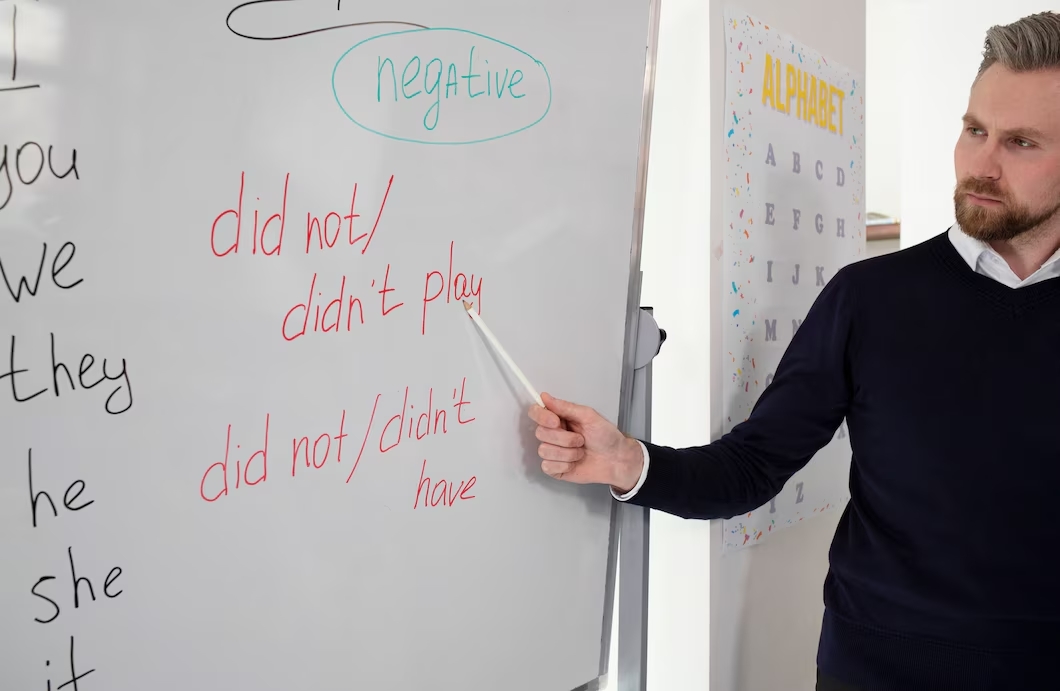
How to create a language environment in the classroom
Anatoliy Zagnitko's Modern Linguistic Dictionary (Vinnytsia: Tвори, 2020) provides the following definition of a language environment: ‘the set of social, cultural, educational, and communicative conditions in which the language and speech of an individual or community is formed, functions, and develops.’ In other words, it is the environment in which language learning takes place. However, in English, the term language environment is used less frequently than the more accurate language immersion.
A language environment can be:
- natural — when learning takes place in a country where the language is spoken;
- artificial — when the environment is created using teaching tools and methods that imitate natural communication.
Who needs it? Without exaggeration — everyone who is learning a foreign language. But experts note that it is more effective to immerse yourself in the language environment when you already have basic knowledge. It is more difficult for beginners to create an environment and adapt to it. For example, before travelling abroad, most people first learn a few dozen of the most commonly used phrases to feel more comfortable.
That is, if we want to be successful in learning, we should give students a comprehensive understanding of certain phrases and basic rules. To do this, in addition to exercises directly in the classroom, it is necessary to:
- listen to music in English, sing or analyse song lyrics;
- listen to audiobooks and radio (BBC Radio 4);
- watch TV series and films in English;
- watch TED Talks or videos on YouTube;
- read books in their original or adapted versions;
- subscribe to English-language media newsletters;
- read blogs and news;
- communicate with native speakers — in person or online;
- join language clubs or create your own English-speaking clubs;
- use CouchSurfing to exchange experiences and practise conversation;
- correspond with foreigners;
- keep a blog or diary in English.
Let this be homework for your students and help them start thinking in English, at least partially.
Effective methods for developing oral speech: 7 interesting tips on how to practise conversational English
It is necessary to convey to students that during oral communication, the interlocutor evaluates not only the content of speech, but also the coherence of the statement, logic, variety of grammatical structures, intonation, sequence of thoughts, and even non-verbal skills — gestures, facial expressions, confidence. To help students develop their speech, the following practical techniques should be implemented in class:
- Watching public speeches and films.
It is useful to watch short excerpts from films or public speeches in class. This helps to develop facial expressions, intonation and gestures. You can ask students to watch the video without sound and guess what it is about based only on the emotions and movements of the characters, and only then turn on the sound — this will be much more interesting. - Practising the skill of asking questions in different ways.
In class, we should teach students to formulate open-ended questions that require a detailed answer. After watching a video or listening to an audio recording, students should compose 10 questions beginning with the words: How do you think…? Why…? In what way…? After that, they work in pairs — one asks questions, the other answers. Then they switch roles. - Working with adjectives.
To make speech more vivid, students should be taught to actively use adjectives. Technique: take any object (for example, a chair) and ask students to come up with 10 adjectives that describe it (wooden, comfortable, old-fashioned, tall…). Then come up with 10 more inappropriate adjectives (shy, rainy, jealous…). This exercise not only develops speech, but also adds a touch of humour to the lesson. - Board language games.
Games are a great way to stimulate speech. We use Scrabble or Taboo. In Scrabble, students compose words, enriching their vocabulary. In Taboo, you have to describe an object without using certain forbidden words. This forces you to think creatively and develops descriptive speech skills. - Working with idioms.
To make speech more natural and expressive, it is worth introducing students to English idioms in class. Technique: learn 1-2 new idioms every day (break the ice, once in a blue moon, the ball is in your court) and try to use them in your own speech or dialogues. - Practising monologue speech.
To develop the ability to speak independently, it is worth practising short speeches. Technique: choose any topic or subject (spring, sea, favourite book) and talk about it for 3-5 minutes, using epithets, comparisons and emotional expressions. - Speech control — ‘filler words’.
You can introduce a language game without filler words in class. Students should avoid words such as well, you know, kind of, actually. For each ‘filler word,’ there is a penalty: throw a coin into a piggy bank or do 5 squats. This is a good way to encourage attentive responses and improve speech clarity.
And, of course, reading is the best foundation for speech development if you have enough time in class.

Common student difficulties and how to overcome them
The main factor that demonstrates a teacher's skill is how they solve the problems their students encounter during their studies. The most common ones are:
- Fear of mistakes and shyness.
- Lack of vocabulary.
- Problems with pronunciation.
- Uncertainty about grammar.
- Lack of a language environment.
It is important for the teacher to create a supportive atmosphere where mistakes are seen as part of the learning process. Vocabulary can be expanded by systematically introducing new words in a natural context and actively using them in dialogues. To overcome difficulties with grammar, rules should be explained through the practice of live speech, rather than dry diagrams. Pronunciation is improved by listening to authentic materials and repeating after the speaker. In the absence of a language environment, it is worth encouraging students to watch films, listen to English-language podcasts, read and communicate online. Interesting topics, role-playing games, and a sense of progress after each speech activity help to maintain motivation.
Using these principles, a conversational English lesson can be effective and interesting. We wish you success!
Other news

210
0

Oleksandra Kulish
Book expert
20 February 2026

185
0
Oleksandra Kulish
Book expert
19 February 2026

499
0
Oleksandra Kulish
Book expert
30 January 2026
Study resources
Children's
Story Books
Children's Encyclopedias
Arts & Crafts
Pop Culture
Early Years
Sticker & Activity books
Christmas

Detectives for children
Sci-fi and fantasy for children
Books about religions for children
Books for children about sports
Stories and tales about animals for children
History books for children
Children's fairy tales and myths
Children's books about computers and technology
Children's comics and graphic novels
Children's classic books
Biographical books for children
Children's books about art and music
Книги о животных и растениях для детей
Adventure novels for children
 ArrivalsNew Sale