






Modal verbs in English: rules of usage and common examples

Oleksandra Kulish
Book expert
Modal verbs often cause difficulties: they have their own peculiarities that need to be remembered well. In addition, the meanings of some modal verbs coincide or differ only in minor nuances. Sometimes the choice of a particular modal verb depends only on the degree of politeness or formality of speech.
Let's figure out how modal verbs differ from regular verbs in English and learn how to use them in different situations according to the rules of grammar.
What are modal verbs in English?
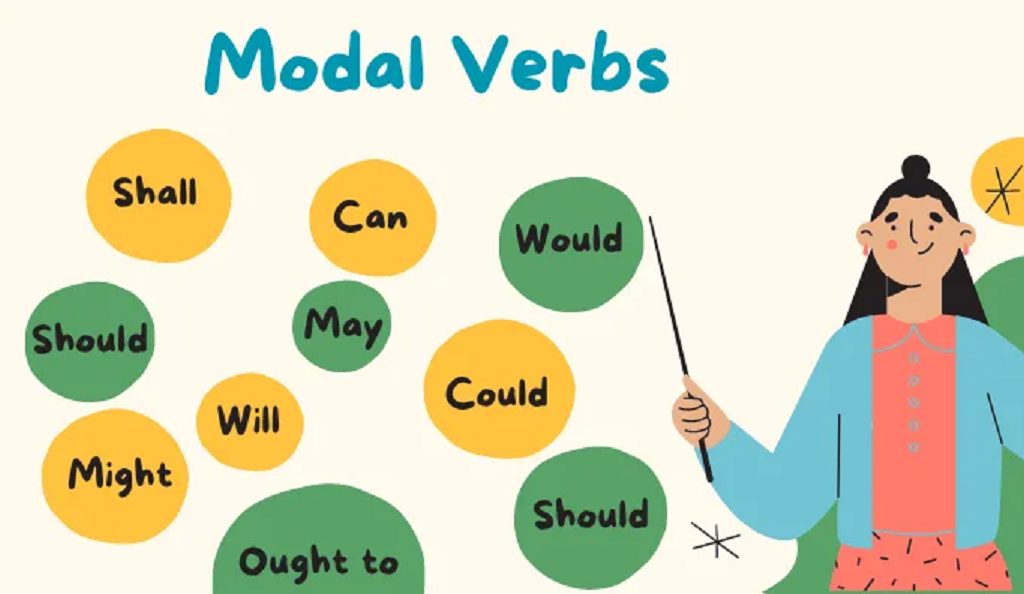
Modal words in English are a small group of special verbs. They differ from regular verbs in that they do not express specific actions or states on their own, but convey the speaker's attitude toward these actions: evaluation, possibility, obligation, probability, permission.
In Ukrainian, we use words such as “can,” “must,” “able,” “obliged,” “allow,” and “need” for this purpose. Examples of such sentences:
- I can ride a bicycle.
- I may join the meeting later. — I can join the meeting later.
According to the rules of grammar, English modal verbs cannot exist on their own: they must be accompanied by a regular verb in the infinitive without the particle to in order to show what exactly should be done. Together, the modal verb and the infinitive form a compound modal predicate.
The main verb always follows the modal verb in the infinitive form. Exceptions: “be to,” “ought to,” “have to,” and “have got to” retain the particle “to,” while the rest of the verbs are used without it.
Examples of modal verbs in use:
- You should read this book.
- Shall we start the project?
- I must reply to this email today.
- I can’t buy that laptop, it’s too expensive. — I can't buy that laptop, it's too expensive.
Obviously, the choice of modal verb depends on the situation and the speaker's degree of certainty.

Modal verbs in English: rules
Let's take a look at what modal verbs are, what they mean, and how they differ from each other.
Modal verbs can and could
Can — “to be able to,” “to be capable of,” “to have the ability or capacity to do something.”
- My brother can cook Italian food.
- I can’t swim well, but I can help you with the kayak.
- Can I borrow your notebook?
- Can’t you speak louder?
Could — “could” in the past tense. It is also a polite form for a request.
- Could you send me the report, please?
- I could play chess when I was ten.
- Despite the noise, I could hear the birds singing.
If you are sure that an event in the past is impossible, use can’t have + the third form of the verb (-ed):
- She can’t have missed the train — it left on time.
- Can is also used when we politely ask for permission to do something.
Modal verbs must and have to
Must — “must,” ‘obligated’ to do something on your own. Have to — “forced,” “compelled” by circumstances.
- I must finish this book before the exam.
- Yesterday I stayed late at work because I had to submit the report.
In negative sentences, the meaning changes:
- mustn’t — strictly forbidden: You mustn’t touch the paintings in the gallery.
- don’t have to — not necessary: You don’t have to attend the meeting if you’re busy.
Thus, must is used to express personal obligation or prohibition, while have to indicates a necessity caused by external circumstances, or that the action is not mandatory in the negative form.
Modal verbs should and ought to
Should — “should,” used for advice and recommendations.
- You should drink more water every day.
- They shouldn’t ignore the warning signs.
Ought to — synonymous with should, similar meaning:
- You ought to check your emails regularly.
- They ought not to waste time on unimportant tasks.
Thus, should and ought to help to tactfully express advice or an expected action without imposing a strict obligation, but only emphasizing the desirability of certain behavior.
Modal verbs may and might
May — “can,” “possibly.” In questions, it is often used as a polite form of request.
- He might have left early yesterday, that’s why he wasn’t at the meeting.
- They might visit us next weekend if they’re free.
So, may and might are used to express probability or assumption, with may often sounding more confident or polite in requests, and might conveying a more uncertain possibility.
Modal verbs will and would
Will is used to express future actions, intentions, instant decisions, promises, or confidence in something.
- I will call my friend tomorrow evening.
- She will surely pass the exam.
Would is the past form of will and is used for polite requests, suggestions, descriptions of hypothetical situations, and repeated actions in the past.
- He said he would help me with the project.
- If I had more free time, I would start learning Japanese.
You can look at it this way: will seems to “push” the event forward and shows a willingness to act here and now, while would creates distance — in time, politeness, or imagination — making the statement less direct and more flexible.
The modal verb shall
Shall is mainly used in British English for suggestions, promises, official orders, or plans.
- Shall we begin the presentation now?
- You shall not enter without permission.
- Shall can replace will in the formal future tense with I and we, although it is considered an outdated form.
The modal verb need
Need expresses necessity and can be used as a regular verb (with to) or as a modal (without to) in questions and negations.
- You need not worry about the schedule.
- Need I arrive earlier tomorrow?
In other words, need emphasizes not the obligation but the advisability of an action, allowing one to speak about necessity in a more neutral and less pressuring way.
The modal verb dare
Dare means “to dare” or “to have the courage” to do something. In the modal form, it does not require auxiliary verbs in questions and negations.
- I dare not speak up in the meeting.
- Dare you question the decision?
In this case, dare functions as a linguistic marker of courage or an internal barrier, emphasizing the psychological aspect of the action rather than the fact of its execution.
The construction used to
Used to describes regular or habitual actions in the past that no longer occur, or states in the past.
- I used to jog every morning before work.
- There used to be a bookstore here, but it closed years ago.
Used to differs from would in that it can describe both states and repeated actions in the past, while would is only used for repeated actions.
Indirect speech and modal verbs
When switching from direct to indirect speech, some modal verbs change form, while others remain unchanged. Let's see how this works:
|
Modal verb |
Direct speech |
Indirect speech |
|
might, should, ought to, would, could — do not change |
He said, “You should check your email.” |
He said that I should check my email. |
|
After a modal verb, the verb is in the continuous or perfect form — these do not change. |
“She must have left early,” I thought. |
I thought that she must have left early. |
|
can → could |
Anna said, “I can fix this computer.” |
Anna said that she could fix that computer. |
|
shall → should / could |
John asked, “What shall I tell them?” |
John wondered what he should tell them. |
|
may → could / might |
“You may enter the classroom now,” the teacher said. |
The teacher said that we could enter the classroom. |
|
must → had to (exception: if expressing a supposition, the form does not change) |
Kate said, “I must finish this assignment today.” |
Kate said that she had to finish that assignment that day. |
|
will → would |
Mark said, “I will send you the file tomorrow.” |
Mark said that he would send me the file tomorrow. |
Modal verbs are a broad topic with many nuances. But if you learn gradually, step by step, you will quickly master them.

479
0

Oleksandra Kulish
Book expert
20 February 2026

384
0
Oleksandra Kulish
Book expert
19 February 2026

899
0
Oleksandra Kulish
Book expert
30 January 2026
Study resources
Children's
Story Books
Children's Encyclopedias
Arts & Crafts
Pop Culture
Early Years
Sticker & Activity books
Christmas

Detectives for children
Sci-fi and fantasy for children
Books about religions for children
Books for children about sports
Stories and tales about animals for children
History books for children
Children's fairy tales and myths
Children's books about computers and technology
Children's comics and graphic novels
Children's classic books
Biographical books for children
Children's books about art and music
Книги о животных и растениях для детей
Adventure novels for children
 ArrivalsNew Sale